Driving licence in Denmark – exchange rules, car tax, bridge tolls and travel after Rejsekort
Last updated 25 September 2026Rules checked every MondayOfficial sourcesSources & methodology →
Whether your driving licence in Denmark needs exchanging depends on where it was issued, and the clock starts when you settle. Here are the exchange rules, the 2026 registration tax, bridge tolls and how public transport works now that the physical Rejsekort is gone.
Your driving licence in Denmark is the first thing to check, because its clock starts when you settle. Getting around also changed in 2026. The physical Rejsekort travel card shut down on 30 June 2026, and money left on cards was transferred to holders' NemKonto accounts. The Øresund Bridge's current prices have applied since 14 September 2026. And the 2026 car registration tax rates apply only if the Danish Parliament adopts Bill No. 79 of 19 November 2025.
Can I drive in Denmark on my foreign driving licence?
It depends on where the licence was issued. Time limits count from when you take up normal residence, which generally means settling in Denmark intending to stay at least 185 days a year because of personal or business ties.
| Licence issued in | Driving on it in Denmark | Exchange for a Danish licence |
|---|---|---|
| An EU or EEA country, or the Faroe Islands | Yes – the same vehicle categories, subject to Danish age requirements | Not required |
| Greenland | Up to 180 days after you settle | Required, including a driving test |
| Group 1, including Great Britain, Northern Ireland, Switzerland, Japan, South Korea, Taiwan, Ukraine and Brazil | Up to 180 days after you settle | As a rule without a driving test |
| Group 2: the USA, Canada, Australia, New Zealand, Singapore, Chile, Israel, Serbia, Bosnia-Herzegovina and the Isle of Man | Check with Færdselsstyrelsen (the Danish Road Traffic Authority) | Without a driving test |
| Any other country | Up to 180 days after you settle | Only after passing a full driving test, theory and practical |
Source: Færdselsstyrelsen and Life in Denmark, read 23 September 2026.
One more case: if your licence was issued by a country that has since left the EU or EEA, while it was still a member, it is valid for at most 180 days after the country left or after you settle, and must then be exchanged.
How do I exchange my licence for a Danish driving licence?
You exchange a foreign licence through your municipality once your stay in Denmark has lasted more than six months; that condition does not apply to Faroese, Greenlandic or EU/EEA licences.
For a first Danish licence, you apply with proof of identity, a photo, a medical certificate from your own GP that is less than 6 months old, and a certificate showing you have completed a course in traffic-related first aid.
Later, watch the expiry date: a Danish licence expired for 3 years or more can only be renewed after a new driving test. Questions about foreign licences go to Færdselsstyrelsen in Ribe on +45 7221 8899, Monday to Thursday 9.30am–3.00pm and Friday 9.30am–2.00pm.
What does it cost to bring or buy a car in Denmark?
If you bring a car on foreign number plates, you must register it in Denmark no later than 30 days after you move. Notify Motorstyrelsen (the Danish Motor Vehicle Agency) online before importing it; if you have had no response within 30 days, you may no longer drive it on foreign plates.
From another EU country there is no customs duty, but 25 per cent VAT if the car is new. From outside the EU, you generally pay 10 per cent customs duty and 25 per cent VAT on the invoice price plus freight and costs, on top of registration tax. The exception is moving house: if you have lived outside the EU for at least 12 consecutive months and meet the other conditions, Toldstyrelsen (the Danish Customs Agency) lets you bring personal belongings, including private vehicles and bicycles, free of duty and VAT.
The big cost is registreringsafgift (registration tax). Motorstyrelsen's 2026 rates apply only if the Danish Parliament adopts Bill No. 79.
| Private cars, 2026 (subject to Bill No. 79) | Registration tax |
|---|---|
| First DKK 76,400 of taxable value | 25 per cent |
| DKK 76,400 to 237,400 | 85 per cent |
| The rest | 150 per cent |
| CO2 surcharge, 0–107 g/km | DKK 294 per gram |
| CO2 surcharge, 107–137 g/km | DKK 587 per gram |
| CO2 surcharge, above 137 g/km | DKK 1,115 per gram |
| Zero-emission car, e.g. electric, registered before 2027 | 40 per cent of the calculated tax; basic deduction DKK 161,300 |
| Low-emission car (0–50 g/km, typically a plug-in hybrid), registered in 2026 | 68 per cent of the calculated tax; basic deduction DKK 43,000 |
Source: Motorstyrelsen (the Danish Motor Vehicle Agency), read 23 September 2026.
For zero-emission cars, the tax is then phased in gradually until it is fully phased in during 2036. Motorstyrelsen answers import and registration questions on +45 72 22 27 96.
Motor liability insurance is compulsory. In 2026 it must cover at least DKK 153 million per accident for personal injury and DKK 30 million for property damage. Driving uninsured costs DKK 250 a day, charged by the Danish Motor Insurers' Bureau (DFIM), plus a DKK 1,000 police fine if you are stopped.
Are Danish motorways and bridges free?
Apart from the Great Belt Bridge (Storebælt), between Zealand and Funen, and the Øresund Bridge between Copenhagen and Sweden, the entire motorway network is free. General speed limits for ordinary cars are 110–130 km/h on motorways, 80 km/h on highways and 50 km/h in towns, unless signs say otherwise. On both bridges, paying on the spot is the dearest option:
| Crossing | Price or discount | Condition |
|---|---|---|
| Øresund Bridge, car up to 6 m, single trip | DKK 470 at the toll station, DKK 420 with an online ticket, DKK 182 with ØresundGO | Prices valid from 14 September 2026 |
| ØresundGO agreement | Annual fee DKK 370; 60 per cent discount on every crossing | A continuous discount agreement |
| Great Belt Bridge, card or cash | Full price | No discount |
| Great Belt Bridge, Bizz tag or number-plate payment | Express price | Discounted automatically |
| Great Belt Bridge, Storebælt Private agreement | Evening discount DKK 246 return (16:00–03:00); weekend or public holiday discount DKK 346 return | Cars under 6 m and motorcycles |
| Great Belt commuter discount | Automatic for private customers | More than 14 crossings in one calendar month |
Source: Øresundsbro Konsortiet and Sund & Bælt, read 23 September 2026.
How does public transport work after the Rejsekort closure?
The physical Rejsekort closed on 30 June 2026 (any balance went to your NemKonto, part 4). Instead, you travel with one of these:
| Ticket option | Format | If you commute |
|---|---|---|
| Rejsekort app | App | Add Pendler Kombi |
| Basiskort | Physical card | Add Pendler Kombi |
| Rejsebillet app | App | Buy a Pendlerkort (commuter card) in the app |
Source: Rejsekort & Rejseplan A/S, read 23 September 2026.
Regional operators switched too: Midttrafik, which covers Aarhus, lists 'Changes from 28 June 2026' and offers the same products alongside its own app. In Greater Copenhagen, the bus operator Movia is behind the DOT (Din Offentlige Transport) commuter-card system. Aarhus, Odense and Aalborg share one fare scale, Takst Vest.
| Adult 30-day Pendlerkort, 2026 | 2 zones | 3 zones |
|---|---|---|
| Copenhagen and Zealand (DOT), plus DKK 70 for the metro | DKK 530 | DKK 710 |
| Aarhus (Midttrafik) | DKK 435 | DKK 585 |
| Odense (FynBus) | DKK 435 | DKK 585 |
| Aalborg (Nordjyllands Trafikselskab) | DKK 435 | DKK 585 |
Source: DOT, Midttrafik, FynBus and Nordjyllands Trafikselskab, read 23 September 2026.
In Aarhus, yellow city buses run six main A-lines, 1A to 6A, and the Letbane (light rail) runs to Djursland, Odder and Grenaa. Odense has a light rail line of just over 14 km.
Trains and bikes
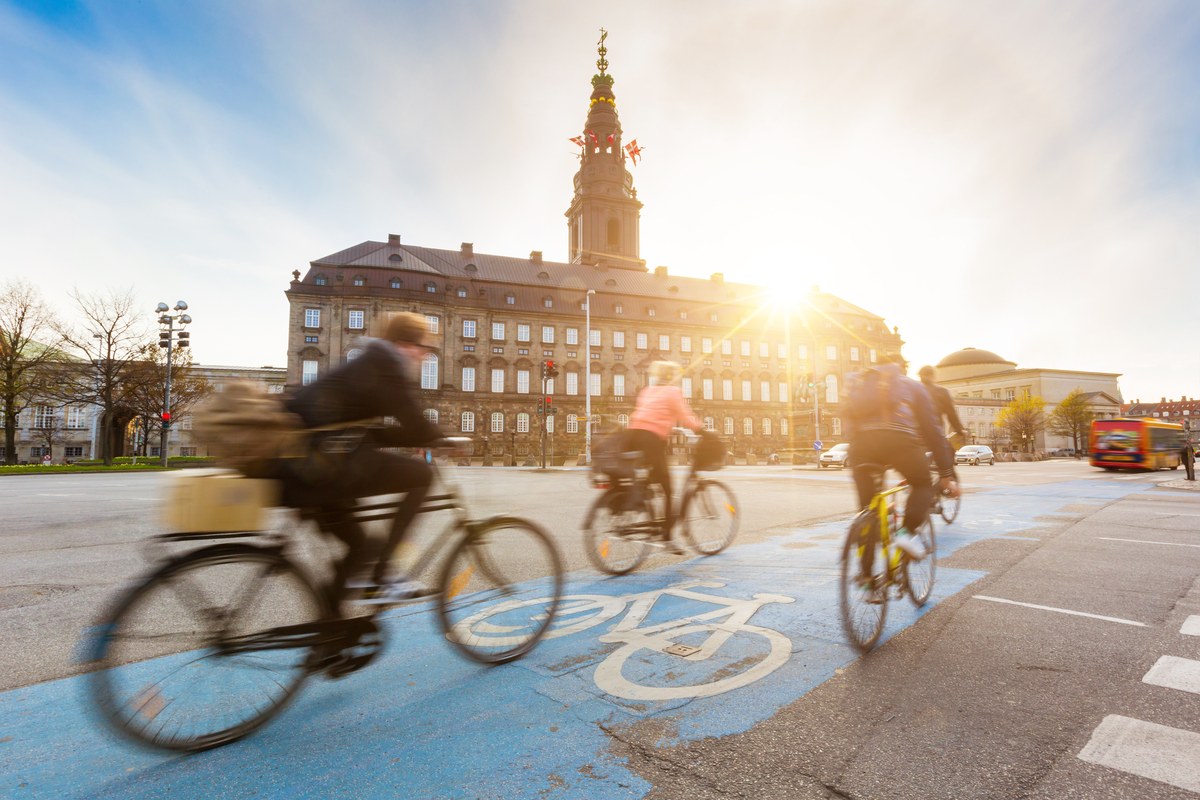
Between cities, the train takes about 1.5 hours from Copenhagen to Odense, 3 hours to Aarhus and 4 hours to Aalborg. Within cities, many people cycle: Denmark has more than 4.5 million bikes, almost one per resident, and in Copenhagen cycling is the most popular way to get around.
What to do now
| Step | What | When |
|---|---|---|
| 1 | Find your licence's group in the table above | Before you move |
| 2 | Ask Færdselsstyrelsen or your municipality about exchanging a non-EU/EEA licence | Soon after you settle – the 180 days count from then |
| 3 | Notify Motorstyrelsen before importing a car, then register it | Within 30 days of moving |
| 4 | Take out motor liability insurance | Before you drive |
| 5 | Sign up for ØresundGO or a Storebælt Private agreement if you cross often | Before your first regular crossing |
| 6 | Get the Rejsekort or Rejsebillet app, or a Basiskort | Before your first trip |
Source: Færdselsstyrelsen, Motorstyrelsen, Øresundsbro Konsortiet, Sund & Bælt and Rejsekort & Rejseplan A/S, read 23 September 2026.
Official sources
The official pages this guide is based on, read 23 September 2026. Links open the authority’s own website.
- Færdselsstyrelsen / Danish Road Traffic Authority · danishroadtrafficauthority.dk
- Færdselsstyrelsen / Danish Road Traffic Authority · danishroadtrafficauthority.dk
- Life in Denmark · lifeindenmark.borger.dk
- Motorstyrelsen / Danish Motor Vehicle Agency · motorst.dk
- Motorstyrelsen / Danish Motor Vehicle Agency · motorst.dk
- Life in Denmark · lifeindenmark.borger.dk
- Life in Denmark · lifeindenmark.borger.dk
- Sund & Bælt / Storebælt · storebaelt.dk
- Øresundsbro Konsortiet · oresundsbron.com
- Rejsekort & Rejseplan A/S · rejsekortrejseplan.dk
- Rejsekort & Rejseplan A/S · rejsekort.dk
- Midttrafik · midttrafik.dk
Relocate in Europe provides general information, not legal or financial advice for your individual situation. Check with the authority named above before you act – rules change, and your case may differ.