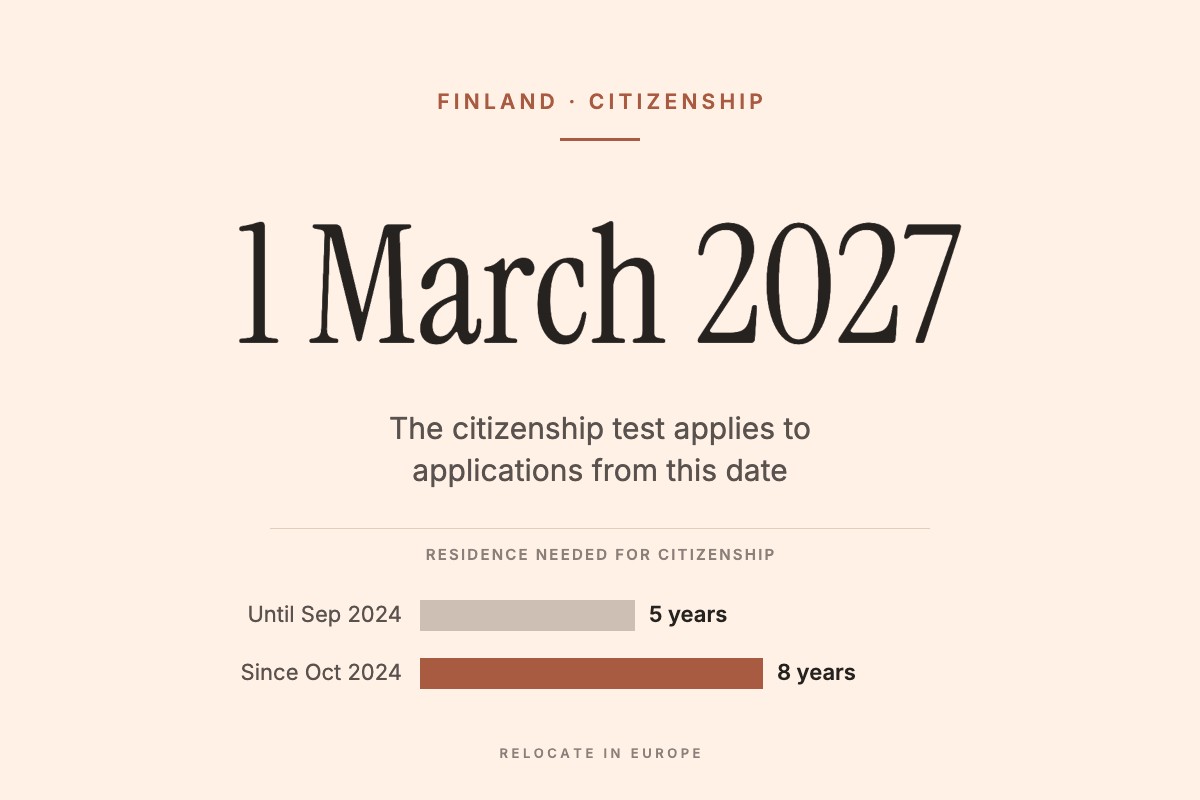
Changes to Finland's Citizenship Act take effect on 1 January 2027. Adults aged 18 to 64 who apply from 1 March 2027 will need to pass a test on Finnish society, rights and history, the Finnish Immigration Service says.
By The editorial team · 2 min read · 27 September 2026
In less than two years Finland, Portugal, France and Sweden have lengthened the clocks, added tests and raised the bar for staying for good. The rules differ, but they share a logic, and…
Across Europe the road to staying for good now runs through dates on documents. After four moves, my advice is old-fashioned: the first residence card you are given may be the most…
Moving to Europe: the rules for each journey, before you choose your country
Moving to Europe means one of two journeys: coming from outside the EU, or moving within it as an EU, EEA or Swiss citizen. Here are the rules for each – the Schengen 90/180-day rule, EES, ETIAS, the EU Blue Card and free movement – before you choose your country.
Moving to Europe can mean two different things. If your passport is from outside the EU, you are coming to Europe from outside: short visits follow common Schengen rules, and a longer stay needs a visa or permit from your new country. If you are an EU, EEA or Swiss citizen, you are moving within Europe under free movement.
Living in Europe as a foreigner starts with that distinction, so this guide follows it: choose your situation, read the rules that apply, then choose your country. Fourteen countries already have complete guides – Sweden, Norway, Denmark, Finland, the UK, Ireland, Germany, the Netherlands, France, Spain, Portugal, Italy, Switzerland and Monaco – and more will follow.
Coming to Europe from outside the EU
If you plan to move to Europe from outside the EU, EEA and Switzerland, these are the EU rules that shape your move.
Schengen and the 90/180-day rule
The 90/180-day rule decides how long you can stay before you need a national visa or permit.
Rule
What it means for you
Members
29 countries: 25 of the 27 EU countries plus Iceland, Liechtenstein, Norway and Switzerland
Ireland and Cyprus
Ireland opts out with its own visa and border policy; Cyprus takes part, but border controls with it have not yet been lifted
Short stays
Up to 90 days in any 180-day period, with a visa or visa-free depending on nationality
Counting days
The 180-day period starts when you enter; you may come and go, but stay no more than 90 days in total within it
Schengen visa
Generally valid for every Schengen country
Passport
Valid for at least 3 months after you intend to leave
Longer stays
A visa under national procedures
Source: European Commission (Migration and Home Affairs) and Your Europe, read 23 September 2026.
The Entry/Exit System (EES) – live since 12 October 2025
The EES records the biometric data and entry and exit dates of non-EU short-stay travellers. Its phased rollout began on 12 October 2025; since 10 April 2026 it has been fully operational at all external Schengen border crossing points, with over 145 million entries and exits recorded.
Traveller
EES registration
Non-EU short-stay traveller
Registered
Non-EU national with a long-stay visa or residence permit
Exempt
Non-EU family member of an EU/EEA citizen with a valid residence card from the relative's EU country
Exempt
National of Andorra, Monaco, San Marino or Vatican City/the Holy See
Exempt
Source: European Commission (Migration and Home Affairs), read 23 September 2026.
ETIAS – planned, not yet in force
ETIAS, the European Travel Information and Authorisation System, is planned but not running yet.
ETIAS
As officially stated
Status
Planned – not yet in force
Planned start
The last quarter of 2026; in April 2026 the Commission said the exact date would be communicated later
Fee
EUR 20 (the original proposal was EUR 7)
No fee
Applicants under 18 or over 70
Source: European Commission (Migration and Home Affairs), read 23 September 2026.
Working: the EU Blue Card and the single permit
The EU Blue Card is for highly qualified work. For other jobs, the single permit combines work and residence in one application.
EU Blue Card
Single permit
Legal basis
Directive (EU) 2021/1883; national rules due by November 2023
Directive (EU) 2024/1233 (recast), adopted in April 2024; national rules due by May 2026, replacing Directive 2011/98/EU
Where
25 of the 27 EU countries – not Denmark or Ireland, which have national rules
Not in Denmark or Ireland
Requirements
Higher professional qualifications, a contract or binding job offer of at least 6 months, and a salary threshold of 1 to 1.6 times the average gross annual salary
–
Decision
–
Within 90 days, down from 4 months
Losing your job
3 months to find work, or 6 once you have held the card for 2 years
3 to 6 months of unemployment allowed while the permit is valid
Moving on
Visits of up to 90 days in 180 to other EU countries; after 12 months of legal employment, you may move with your family to work in another EU country on a new Blue Card
–
Source: European Commission (Migration and Home Affairs), read 23 September 2026.
Staying long term: EU long-term resident status after 5 years
In force now
Proposed – not in force
Legal basis
Directive 2003/109/EC, amended by Directive 2011/51/EU
A recast, still under negotiation between the Council and the European Parliament
Residence
5 years, legal and continuous, in an EU country
Periods in different EU countries could be added together
What you get
Rights similar to those of EU citizens
An easier right to move and work in other EU countries
Source: European Commission (Migration and Home Affairs), read 23 September 2026.
Moving within Europe as an EU, EEA or Swiss citizen
EU freedom of movement is the backbone of moving within Europe: as an EU citizen, you have the right to move to any EU country to live, work, study, look for a job or retire. The table shows the EU rules for EU citizens.
When
What applies
Always
Hold a valid national ID card or passport; you cannot be sent home for lacking one alone, though some countries may fine or detain you for not carrying ID
First 3 months
No registration or residence document required; some countries may require you to report your presence
After 3 months
You may have to register and get a registration certificate – issued immediately, for no more than nationals pay for an ID card
Work
You can start, including as self-employed, without waiting for the certificate
Not registering
A possible fine, but you cannot be expelled for this alone
After 5 years
Continuous legal residence gives you the right of permanent residence automatically; the document is optional, costs no more than an ID card and renews automatically
Family
Rights cover EU and non-EU spouses and children, civil and registered partners, parents, other relatives and families of jobseekers; non-EU family members get a residence card
Source: Your Europe, read 23 September 2026.
Which countries: EU, EEA and Switzerland
Group
Countries
Basis
EU (27)
Austria, Belgium, Bulgaria, Croatia, Cyprus, Czechia, Denmark, Estonia, Finland, France, Germany, Greece, Hungary, Ireland, Italy, Latvia, Lithuania, Luxembourg, Malta, Netherlands, Poland, Portugal, Romania, Slovakia, Slovenia, Spain and Sweden
EU free movement
EEA (30)
The EU countries plus Iceland, Liechtenstein and Norway
The EEA Agreement guarantees free movement of persons
Switzerland
In EFTA, but not in the EEA
Its own agreement with the EU, in force since 1 June 2002: the right to enter, live and work, employed or self-employed
Source: European Union, EFTA and EUR-Lex, read 23 September 2026.
Working, health and money across borders
The EU social security rules (Regulations 883/2004 and 987/2009) have applied since 2010 and also apply in Iceland, Liechtenstein, Norway and Switzerland. You are covered by one country's system at a time, with the same rights as its nationals; earlier insurance, work or residence elsewhere counts if needed; and pensions and family benefits can generally be paid to you in another EU country.
Revised coordination rules approved by EU countries in April 2026 are not in force until the European Parliament and the Council formally adopt them and they are published in the EU's Official Journal.
Topic
What the EU rules say
Who to ask
A1 (posted abroad)
Shows you stay insured in your home country while temporarily posted abroad
The competent institution at home
S1 (posted and moving)
Lets you register for healthcare where you are posted, paid by the country that insures you
The institution where you stay insured
EHIC
Free of charge if you have health insurance in an EU country
Your national health insurer
U2 (unemployment benefit)
Export it for 3 to 6 months while job-hunting in one other EU country, after at least 4 weeks as a registered jobseeker (exceptions possible); register there within 7 days of leaving your home employment services
National employment services
Qualifications
Automatic recognition for doctors, general-care nurses, midwives, dental practitioners, pharmacists, architects and veterinary surgeons; otherwise a decision within 3 months of receiving your papers
The authority in your new country
Driving licence
Usually no need to exchange your EU licence; one with no expiry date may have to be exchanged after 2 years of usual residence, and old-style unlimited licences by 2033 at the latest
National authorities where you live
Pensions
Each country pays its share for your periods there, counting periods elsewhere towards eligibility, into your bank account in your EU country of residence
Each pension authority
Bank account
Legal residents of an EU country are entitled to a basic payment account; a bank cannot refuse you just because you do not live in its country
Any bank
Roaming
Roam like at home: no extra charges in other EU countries, Iceland, Liechtenstein, Norway, Moldova and Ukraine, subject to fair use
Your mobile operator
Source: Your Europe and European Commission (Employment, Social Affairs and Inclusion), read 23 September 2026.
There are no EU-wide rules on how your income is taxed when you live or work abroad. You are usually tax-resident where you spend more than 6 months a year, and that country can usually tax your worldwide income; bilateral tax treaties generally relieve double taxation.
Europe in numbers
A snapshot from Eurostat, with the countries in our guides for comparison. Inflation from 2026 uses a revised classification, so compare it with earlier years with care.
Figure
Latest
Source and period
EU population
451,990,314 (+705,756, or +0.16%, in a year)
Eurostat, 1 January 2026
Non-EU citizens living in the EU
30,600,204 (about 6.8% of the population)
Eurostat, 1 January 2025, latest available
EU unemployment rate
6.1% (6.0% in July 2025)
Eurostat, seasonally adjusted, July 2026
EU youth unemployment, under 25
15.1%
Eurostat, seasonally adjusted, July 2026
EU GDP growth
0.7% on the previous quarter (euro area 0.6%); 1.4% on a year earlier
Eurostat, Q2 2026
EU annual inflation (HICP)
3.2%
Eurostat, August 2026
Sweden: unemployment and inflation
8.9% and 0.3%
Eurostat, August 2026
Norway: unemployment and inflation
4.2% and 3.2%
Eurostat, July 2026 and August 2026
Denmark: unemployment and inflation
6.7% and 2.0%
Eurostat, July 2026 and August 2026
Germany: unemployment and inflation
4.0% and 2.9%
Eurostat, July 2026 and August 2026
France: unemployment and inflation
8.3% and 2.6%
Eurostat, July 2026 and August 2026
Italy: unemployment and inflation
5.8% and 3.2%
Eurostat, July 2026 and August 2026
Spain: unemployment and inflation
10.0% and 4.6%
Eurostat, July 2026 and August 2026
Switzerland: unemployment and inflation
5.1% and 0.9%
Eurostat, June 2026 and August 2026
United Kingdom: unemployment and inflation
4.9% and 3.1%
Office for National Statistics, May–July 2026 and August 2026 – national measures
Ireland: unemployment and inflation
5.0% and 3.4%
Eurostat, August 2026 and August 2026
Netherlands: unemployment and inflation
4.0% and 2.8%
Eurostat, August 2026 and August 2026
Portugal: unemployment and inflation
5.7% and 3.6%
Eurostat, July 2026 and August 2026
Finland: unemployment and inflation
9.9% and 2.4%
Eurostat, August 2026 and August 2026
Source: Eurostat, and the Office for National Statistics for the UK, read 23 and 24 September 2026.
Choose your country
The EU sets common rules, but you register, pay tax and find a doctor in one country. Fourteen countries have complete guides so far. Sweden, Denmark, Finland, Ireland, Germany, the Netherlands, France, Spain, Portugal and Italy are in the EU – though Denmark and Ireland do not apply the EU Blue Card, and Ireland is outside Schengen. Norway is in the EEA and Schengen, Monaco is outside both the EU and Schengen and its entry visas are issued by France, Switzerland is in Schengen and has free movement with the EU under its own agreements, and the UK is outside both the EU and Schengen.
14 countries · 218 guides
Fourteen countries, one standard
Fifteen guides for every country – a “who are you” guide for every kind of newcomer, the latest official figures, an address book and the embassies. In the same order as the menu, north to south.
How long can I stay in Europe without a residence permit?
As a non-EU national, up to 90 days in any 180-day period in the Schengen area – with or without a visa, depending on your nationality. For a longer stay, you need a visa under the national procedures of the country you move to.
What is the difference between EES and ETIAS?
The Entry/Exit System is running and records your biometric data and entry and exit dates. ETIAS is planned for the last quarter of 2026 and not yet in force; the fee will be EUR 20, with none for applicants under 18 or over 70.
Which countries issue the EU Blue Card?
25 of the 27 EU countries – not Denmark or Ireland, which use national rules. You need higher professional qualifications and a contract or binding job offer of at least 6 months.
Do I have to register when I move to another EU country?
Not for the first 3 months, though some countries may require you to report your presence. After that you may have to register and get a registration certificate, issued immediately. Failing to register can mean a fine, but not expulsion on that ground alone.
When can I become a permanent resident?
As an EU citizen, the right of permanent residence is automatic after 5 continuous years of legal residence in another EU country. As a non-EU national, 5 years of legal and continuous residence can bring EU long-term resident status; a reform to count years across EU countries is not in force.
Where do I pay tax and social security?
You pay social security contributions in one country at a time; an A1 certificate shows you stay insured at home while temporarily posted abroad. Income tax has no EU-wide rules: you are usually tax-resident where you spend more than 6 months a year, and tax treaties relieve double taxation.
Relocate in Europe provides general information, not legal or financial advice. Checked on 23 September 2026 – rules change, so check with the authority named before you act.
Add Relocate in Europe to your Home Screen: tap Share, then Add to Home Screen.
Search
Runs in your browser – nothing you type is sent or stored. Esc closes · / or CtrlK opens.