The Dutch 30% ruling becomes a 27% ruling on 1 January 2027
Last updated 27 September 2026
Budget Day on 15 September 2026 brought the Tax Plan 2027, but for people recruited from abroad the key date was already in the law: the tax-free allowance falls from 30 to 27 per cent on 1 January, and the salary thresholds rise.
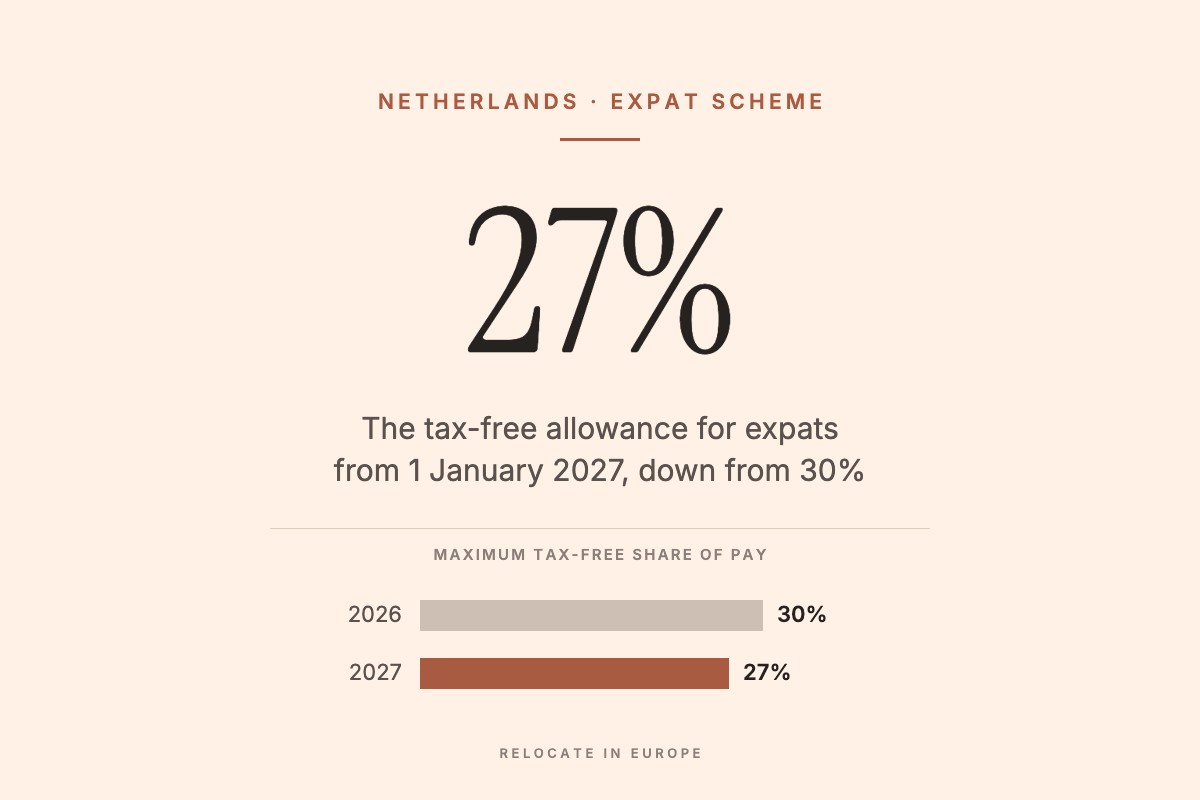
The Dutch government presented its Tax Plan 2027 on Prinsjesdag, Tuesday 15 September 2026. For people moving to the Netherlands for work, the most important change for next year was decided earlier and is already law: the expat scheme, known as the 30% ruling, becomes a 27% ruling on 1 January 2027.
The scheme lets an employer pay part of the salary of an employee recruited from abroad as a tax-free allowance for extra costs, for at most five years. According to the Netherlands Enterprise Agency's business.gov.nl, the employee must have lived more than 150 kilometres from the Dutch border for more than 16 of the 24 months before starting, must have expertise that is scarce in the Dutch labour market, and must earn above a minimum salary set each year. Researchers at designated institutions and doctors training as specialists are exempt from the salary test.
Who keeps 30 per cent
According to PwC's reading of the rules, employees who already had the ruling in the last pay period of 2023 keep 30 per cent for the rest of their term. Everyone else moves to 27 per cent from 1 January 2027. Since 1 January 2026 the allowance has been capped for everyone at the salary limit of the Senior Officials Remuneration Act, €262,000 in 2026. On total pay of €80,000 including the allowance, the tax-free part falls from €24,000 to €21,600.
A second option disappears. The choice to be treated as a partial non-resident taxpayer, which kept savings and investments abroad out of the Dutch tax on assets, closed to new users in 2025. People who had the ruling before 2024 can keep it until the end of 2026, according to business.gov.nl, so from 2027 it is gone for everyone.
Higher salary thresholds
The minimum salary rises too. PwC puts the 2027 thresholds at €50,436 a year, or €38,338 for employees under 30 with a Dutch or equivalent master's degree. The Tax and Customs Administration publishes the final figures before the new year.
What it means if you are moving to the Netherlands
If you start a Dutch job in the coming months, ask your employer to apply for the ruling within four months of your start date, so that it runs from your first day, and check that your salary clears the 2027 threshold, not just this year's. Budget your net pay on 27 per cent, not 30.
Our guide The 30% ruling and income tax in the Netherlands – boxes 1 and 3 in 2026 explains the brackets, the ruling and your first tax return.
Sources: Government of the Netherlands (Rijksoverheid), Prinsjesdag: Tax Plan 2027, 15 September 2026; Netherlands Enterprise Agency (business.gov.nl), the expat scheme (30% ruling) for foreign employees; PwC Netherlands, Prinsjesdag special: "Expatregeling wordt 27%-regeling", September 2026; read 27 September 2026.
Relocate in Europe provides general information, not legal or financial advice. Check with the Tax and Customs Administration (Belastingdienst) before you act.